OSIG Oldenburg Newsletter

Moin dear Open Science friends of Oldenburg (and beyond),

Welcome to the October 2026 edition of the OSIG Newsletter! First and foremost, we are thrilled to welcome a new member to our team: Monica! Welcome on board, Monica; we are excited to have you with us. As always, please feel free to share this newsletter and join our biweekly meetings to help shape the future of open science in our department and beyond!

Previous newsletter issues can be retrieved from the OSIG website.

It has been a productive autumn for the OSIG community, with our members actively hosting workshops and presenting at major conferences across Europe:

  • [BIDS and MEEGqc at COMBINE] Dr. Karel López Vilaret participated in the COMBINE Workshop in Berlin (September 2–4). He presented BIDS Manager and MEEGqc, two open-source tools developed right here to support reproducible multimodal neuroimaging. His presentation highlighted how these tools complement each other, from data conversion and curation to automated quality assessment of MEG and EEG recordings.
  • [ESMRMB 2026 in Girona] Karel also had a massive presence at ESMRMB 2026 in Girona (September 30–October 3). Not only did he showcase the BIDS Manager through a scientific poster and a dedicated demonstration booth, but he also participated in the pre-congress workshop “Imaging without Borders” in collaboration with CAMERA. This hands-on workshop focused on assembling low-field MRI hardware, highlighting the incredible potential of open-source hardware to democratize medical imaging worldwide.
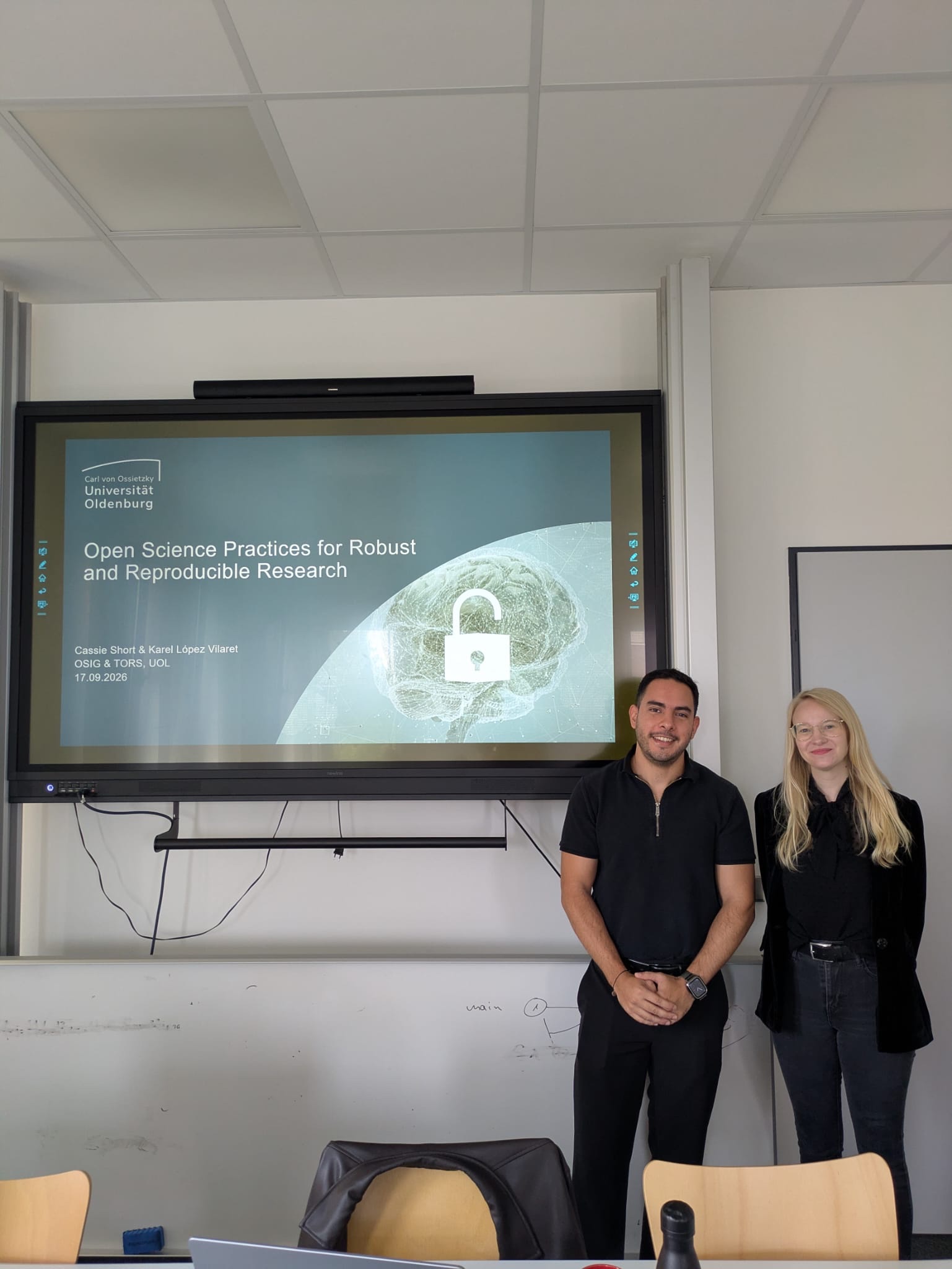
  • [Bremen & Berlin Workshops] September was a busy month for open and reproducible science workshops! Cassie and Karel teamed up to deliver an excellent workshop at the University of Bremen, bringing together PhD students, postdocs, and data management staff. Cassie covered the theoretical side of open science, while Karel led a practical session on the BIDS Manager. The following week, Cassie taught an intensive two-day online workshop titled 'Multiverse Analysis: Making Analytical Uncertainty Transparent' for the IQB Research Data Centre at Humboldt-Universität zu Berlin. Participants learned the conceptual background of multiverse analysis before building, visualizing, and discussing their own multiverse models.
  • Cassie and Karel leading the workshop at the University of Bremen
    Cassie and Karel leading the workshop at the University of Bremen
  • [Practical Project Symposium] Closer to home, on October 20th, Cassie gave students a comprehensive Introduction to Open Science seminar. The session covered key principles like research credibility, reproducibility, transparency, responsible data sharing, and researcher degrees of freedom.
  • [OSIG YouTube Channel] Stay tuned for the launch of the official OSIG YouTube channel! We are planning two exciting streams of content: videos from the UOL Open Science Conference 2025, and a series of exclusive interviews with key characters in the open science movement.
Mark your calendars for these upcoming sessions:

  • [ReproducibiliTea] Sumbul is gearing up for the next round of our ReproducibiliTea journal club! Stay tuned for the official schedule, which will be updated very soon on the OSIG website.
  • [Git Version Control PP Session] As part of the upcoming Practical Project (PP) sessions, Micha will be hosting a hands-on tutorial on using Git. This session will cover the fundamentals of version control, showing you how to seamlessly track changes in your research documents and code, and foster better collaboration. Date and time will be announced shortly!
  • [Replication in Practice at GESIS] Registration is now officially open for Cassie's upcoming 5-day course, 'Replication in Practice'. Taught alongside Nate Breznau from the Leibniz Institute for Lifelong Learning, this course will take place in February 2027 at GESIS in Köln as part of their 'Spring Seminar 2027'. You can register and find more details here.
  • [OSF Platform Changes] The Open Science Framework (OSF) has recently rolled out several updates to its platform interface and project management features. Cassie has put together a helpful summary PDF outlining these changes and how they might affect your daily workflow. This document will be uploaded to our GitHub repository soon, so keep an eye out!
  • [Project ARION Launch] September 2026 marked the launch of the EU-funded project ARION (Advancing Research Assessment through integrated Open practices and Narrative). European research assessment has long relied on outdated metrics, and ARION aims to bridge the gap between CoARA/DORA principles and everyday practice. They are developing tools like Enhanced Digital Researcher Profiles and Narrative CVs to make diverse research contributions (like mentoring and data stewardship) more visible. You can read more about this fantastic initiative here.
  • [UNESCO Open Science Dashboards] The UNESCO Open Science Platform recently launched a new interactive dashboard. Based on a 2025 survey, it provides a fascinating global overview of how member states are implementing UNESCO's Open Science recommendations. You can filter by region and explore the most frequently mentioned challenges in adopting open science infrastructures.
  • For this month's AI section, we are revisiting a critical bottleneck: reproducibility. Verifying whether a published finding holds up when you re-analyze the original data requires someone to track down the files, parse the methods, and rewrite the analysis code. A paper by Holtdirk and colleagues, "Automated reproducibility assessments in the social and behavioral sciences using large language models" (arXiv:2606.13670), introduces an agentic LLM pipeline that acts as an automated data analyst. By feeding the AI the original dataset and the article's text, it independently writes and executes code to test the study's statistical claims! Tested on 180 published studies, the AI successfully reached the same qualitative conclusion 80% of the time. This is a massive step forward in leveraging AI to scale up computational reproducibility checks without adding hours to the peer-review process.
  • This leaves us with compelling questions for discussion: As tools like this become mainstream, should an automated reproducibility check become a mandatory hurdle before human peer review even begins? And more importantly, who takes responsibility for investigating the 20% of cases where the AI fails to replicate the findings? Debating these kinds of questions is exactly what makes our OSIG meetings so interesting. Bring your thoughts to our meeting—we would love to hear your take!
  • A quick note on process: In the spirit of transparency (and integrating AI tools!), this newsletter was polished for readability with the assistance of Google's Gemini 3.1 Pro model. All content and final edits were, of course, reviewed and approved by Daniel before publishing.
  • As we settle into the winter semester, we want to share a quick reminder of the OSIG mission. We are dedicated to promoting transparency and reproducibility in our department, and beyond! We currently have several exciting projects running, including planning the next Open Science Conference, organizing paper discussions, and developing AI-Open Science guidelines.
  • We would love for you to get involved! We meet every two weeks on Tuesdays. Our next meeting is tomorrow, November 3rd, at 10:30 AM in Room A07-036. Please drop by, and let us know if you have any further ideas on what should be included in future newsletters!
Home