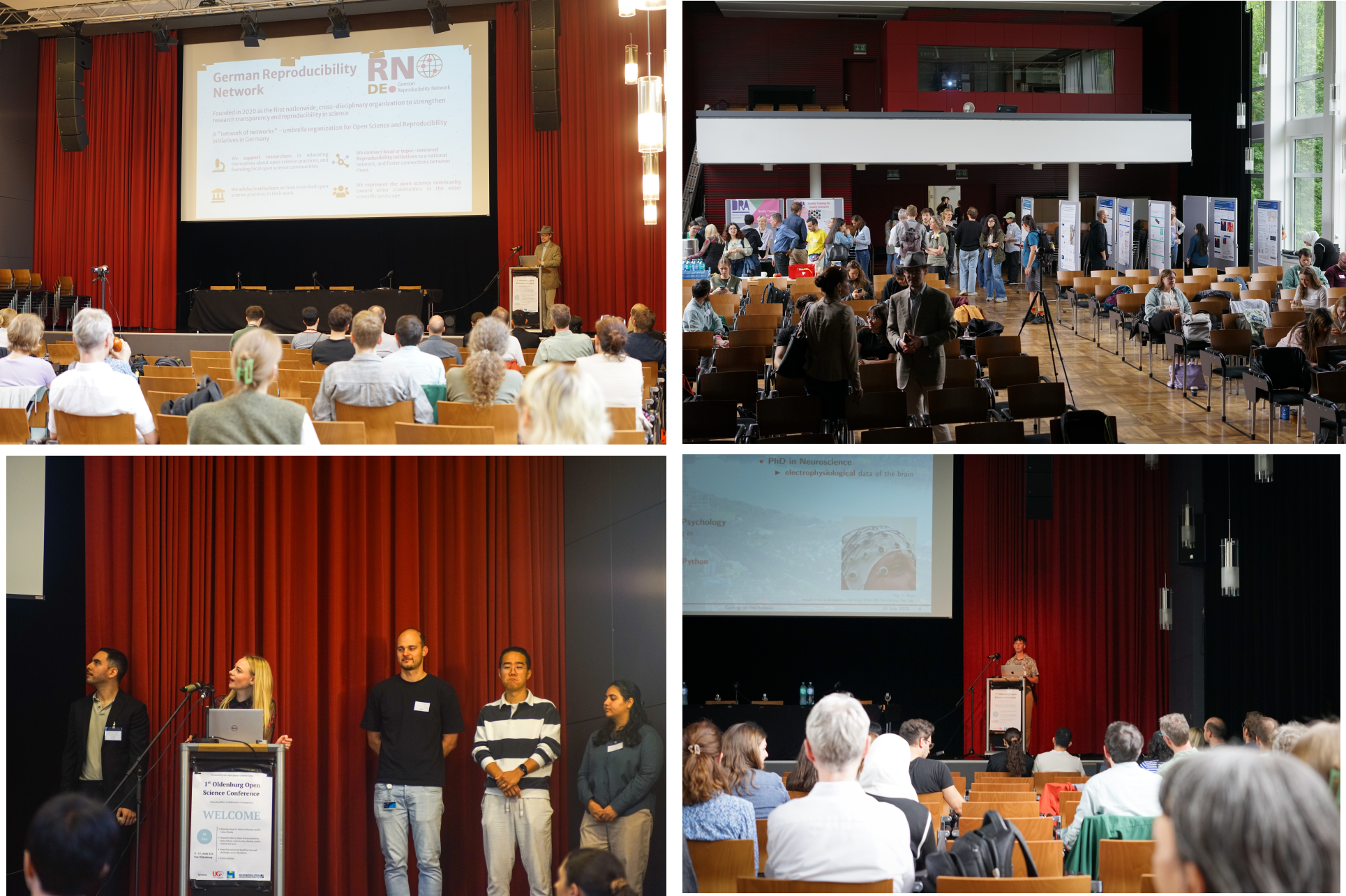
- It’s been a busy and exciting few months for the OSIG community! The highlight of the summer was undoubtedly the first Oldenburg Open Science Conference on July 18th! We were thrilled to welcome over 80 attendees from diverse fields and career stages (from students to professors) coming from Oldenburg, Bremen, Kiel, Trier, Munich, and even Nijmegen. The conference featured amazing talks and lively discussions not just on the why and how of open science, but also on its future – exploring how stakeholders such as universities, funders, and journals can improve its implementation. It was a fantastic day of science! If you missed it, don't worry – the conference materials are available here. We also plan a second Open Science Conference, so stay tuned for updates!
- We also had a strong presence at this year’s DPPD (Differenzielle Psychologie, Persönlichkeitspsychologie und Psychologische Diagnostik) conference! Cassie organized and moderated a well-attended panel discussion on the role of multiverse analysis in achieving scientific rigour. The panel, including Prof. Dr. Jan Wacker (Hamburg), Prof. Dr. Johannes Rodrigues (Würzburg), and Dr. Julia Rohrer (Leipzig) alongside our own Dr. Cassie Ann Short, held a lively and critical exchange on whether multiverse analysis should be a standard practice. The session was a huge success, drawing an engaged audience and receiving highly positive feedback. On top of that, Cassie alsogave a talk in a symposium on machine learning in meta-science, showcasing how modern tools can support open research. Way to go, Cassie!
- Cassie also led an important workshop at the Hanse-Wissenschaftskolleg (HWK) on “Enhancing replicability in EEG individual differences research through individually parameterised single-trial EEG – developing a comprehensive signal quality evaluation strategy.” The workshop was a fantastic example of collaboration, bringing together researchers from our own department – including Andrea Hildebrandt, Stefan Debener, Melanie Klapprott, and Karel López Vilaret – with external experts from Germany, Denmark, and the USA. Together, they discussed strategies to improve methodological transparency, reliability, and validity in single-trial EEG research. The group now plans to collaborate on an open framework for reporting, and we look forward to seeing the results of this exciting initiative!
- October saw an important panel discussion at the IGOR Hackathon (organized by one of our OSIG members, Julius) titled “Have We Solved the Replication Crisis?”. The October 10th session featured a stellar lineup: Andrea Hildebrandt, Britta Westner, Sein Jeung, and Dorothy Bishop, with Gordon Feld moderating. The panel acknowledged significant progress from reforms such as preregistration and registered reports but emphasized that core challenges remain. Key concerns included measurement reliability, software infrastructure vulnerability, and academic incentives that still privilege novelty over rigour. A recurring theme was the need to treat replication as a routine, structurally supported part of science, not just a temporary 'crisis'.
- Our members have also been busy sharing their expertise! Earlier this month, Micha led an interactive session on Open Science methods for PhD students at the KD²School in Bremen. The workshop explored the motivations behind Open Science, from the replication crisis to building trust. Participants discussed how practices like FAIR data, reproducible code, and preregistration make science more robust and collaborative. A key takeaway was that Open Science is a journey, not a checklist. As Micha emphasized, taking any step – such as sharing code or preregistering hypotheses – helps build a stronger culture of openness.