OSIG Oldenburg Newsletter

Moin dear Open Science friends of Oldenburg (and beyond),

Please feel free to share this newsletter and, as always, feel free to join our online biweekly meetings (Tuesdays 10:30-11:30 a.m. on uneven calendar weeks in the study group and A7-0-36: Next meeting on 14th of July) that are open to everyone.

Previous newsletter issues can be retrieved from the OSIG website.

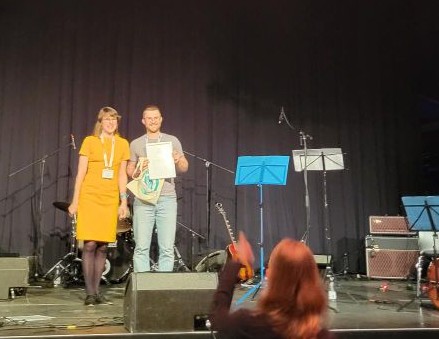
  • [AWARDS] Let's kick off with a massive winning streak from our members. The Society for Improving Psychological Science (SIPS) awarded a 2026 Commendation to the presenters of Love Replications Week. This group includes Cassie. This recognition highlights the immense value of collaborative efforts in pushing psychological science toward better reproducibility. A huge congratulations to Cassie and the entire team for this achievement! The awards just kept coming. Micha took home the Open Science Award at the recent Psychology and Brain (PuG) conference! He received this honor for his outstanding work developing a toolbox for dynamic functional connectivity. You can check out his COMET toolbox publication. We are incredibly proud to see our department's methodological tools recognized on such a large stage. Melanie also secured a major win, taking home the 2nd prize MoBI Award at the MoBI 2026 conference. This prize recognizes her award-winning paper investigating the use of mobile EEG for the study of cognitive-motor interference during swimming. You can view the award details on the MoBI submissions page. Congratulations, Melanie, on this well-deserved recognition of your hard work!
  • Micha receiving award at PuG
    Micha receiving award at PuG
  • [Neuroimaging dataset workshop] Beyond awards, we have been busy sharing skills. On May 19th, Amir, Micha, Sumbul, Wolf, and Karel hosted a highly practical workshop focused on open neuroimaging datasets. They went beyond simply showing attendees where to find open data. Participants actually got their hands dirty learning how to access and actively analyze these large-scale resources. If you missed it, do not worry. We will make all the workshop materials available on the OSIG website soon.
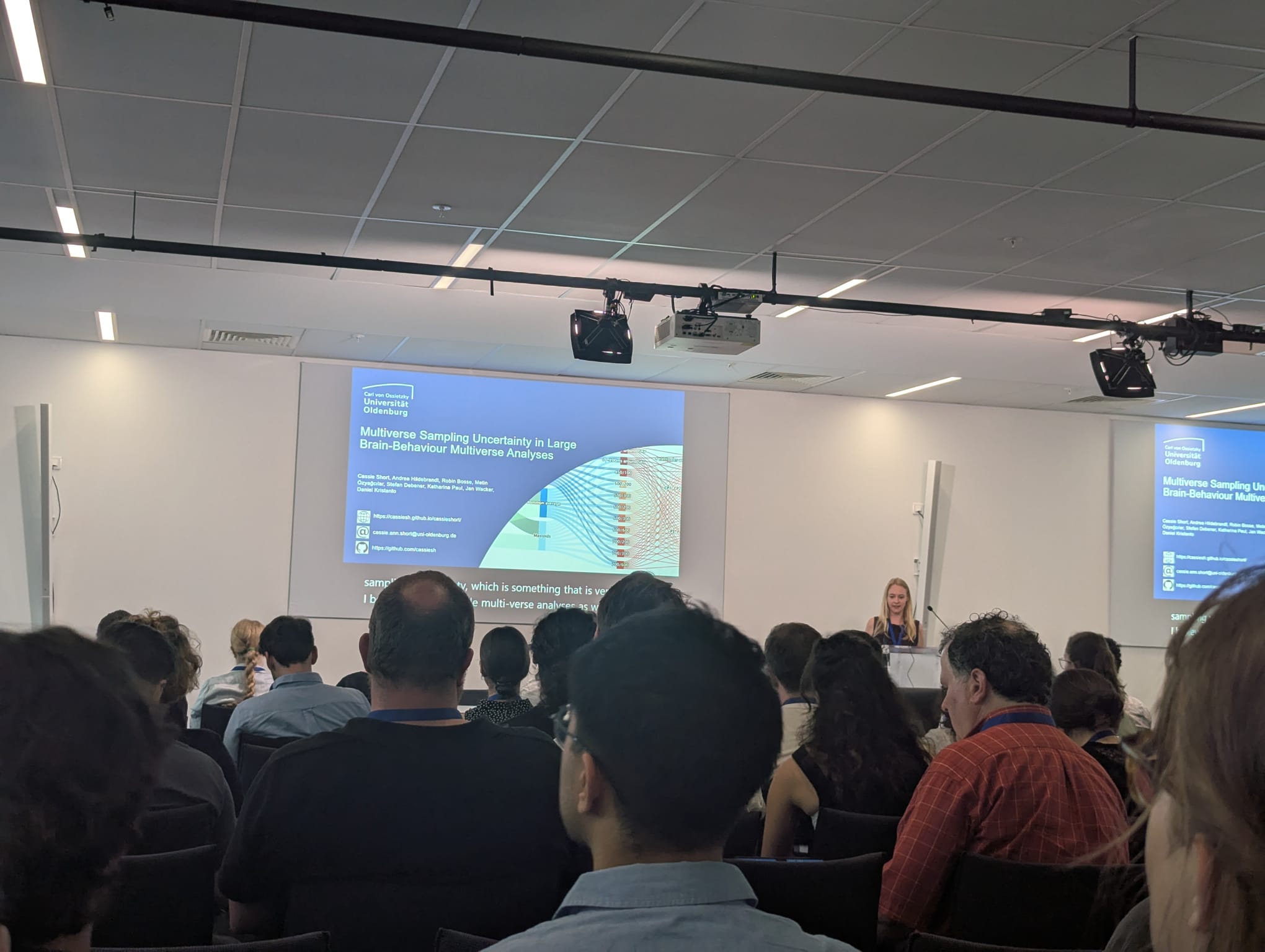
  • [Conferences] We also had a massive presence at recent major conferences. A large delegation from our department traveled to the Organization for Human Brain Mapping (OHBM) meeting. While there, Cassie was invited to upgrade her poster to a full talk! She presented her research on 'Multiverse Sampling Uncertainty in Large Brain-Behaviour Multiverse Analyses,' based on her recent paper. Karel also made a huge impact at the OHBM BrainHack, delivering two hands-on workshops on open and reproducible neuroimaging workflows (we have included the full details on his sessions below!). Meanwhile, Julius, Cassie, and Daniel attended the PuG conference. Speaking of PuG, get ready. Next year's conference will be hosted right here in Oldenburg!
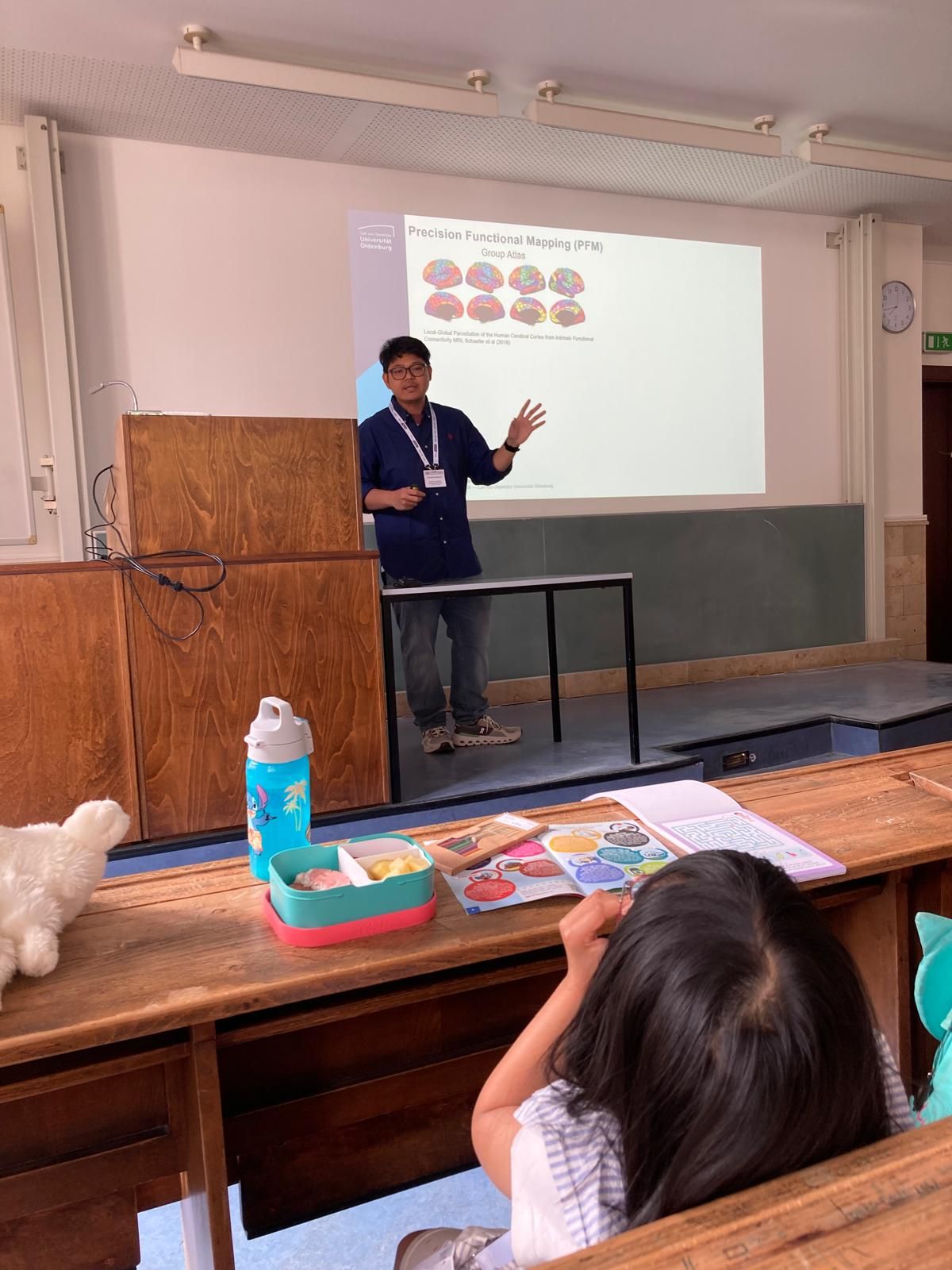
  • Cassie speaking at OHBM Daniel speaking at PuG
    Cassie's talk at OHBM and Daniel's talk at PuG
  • [Workshop in Hearing4All Summer Symposium] Sarah ran a fantastic workshop at the Hearing4All Summer Symposium. She focused on Mobile Neuroscience in Android, showcasing free, open-source apps developed right here in the Neuropsychology lab. These tools let researchers record and stream biosignals using the Lab Streaming Layer (LSL) directly from a smartphone-no bulky laptop required. Want to try them out? Visit the project landing page to download the apps and see exactly how they work.
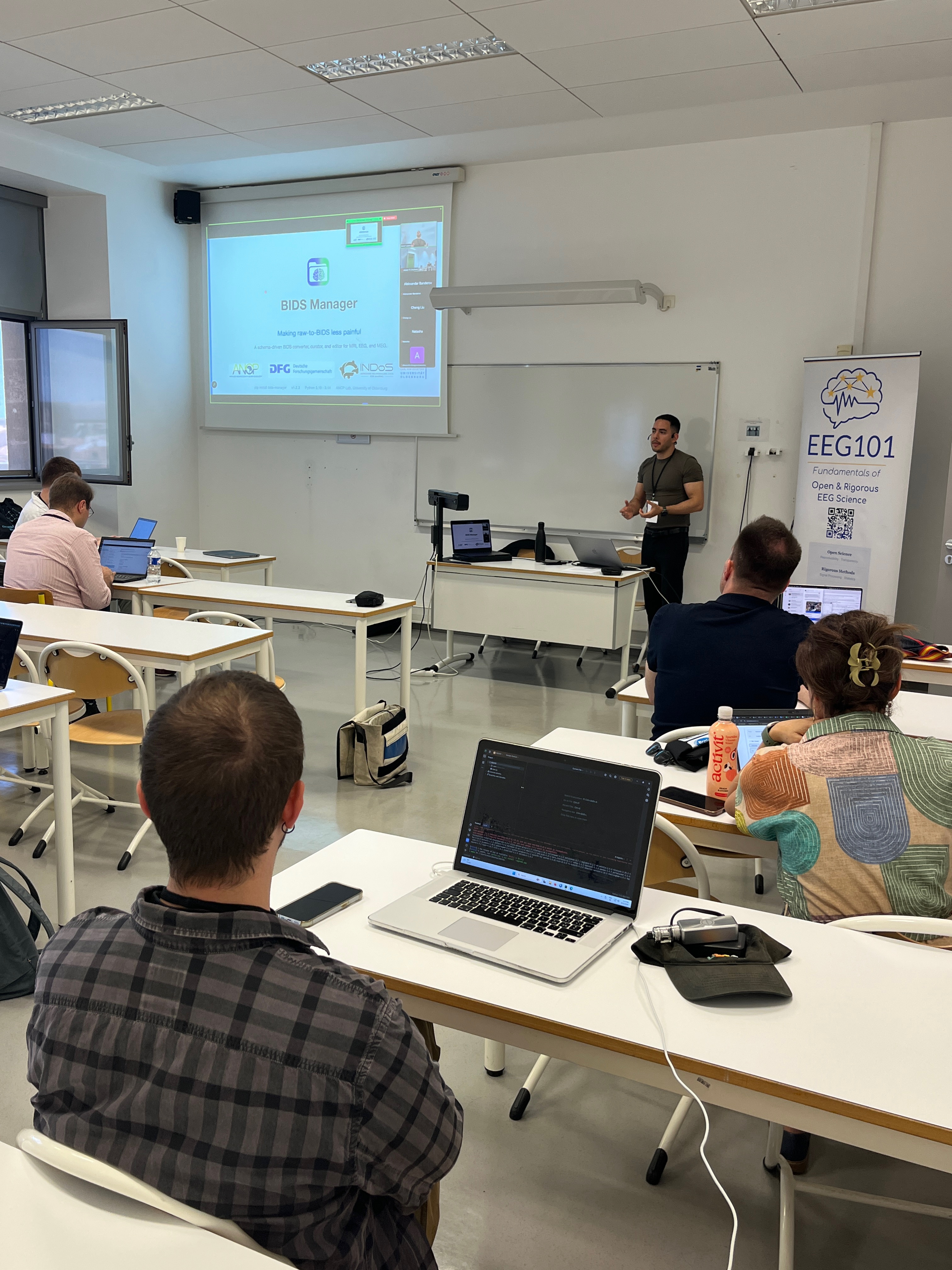
  • [OHBM brainHack workshop] At OHBM BrainHack 2026, Karel contributed to the collaboration between INDoS (COST Action CA24161), EEG101 (COST Action CA21147), and BrainHack by delivering two hands-on workshops focused on open and reproducible neuroimaging workflows. His first workshop introduced BIDS Manager, a software package that simplifies raw-to-BIDS conversion and dataset curation across MRI, MEG, EEG, and physiological recordings. The session demonstrated an interactive workflow for data conversion, metadata editing, BIDS validation, and dataset review. Documentation: BIDS Manager documentation. The second workshop presented MEEGqc, a BIDS-aligned toolbox for standardized quality assessment (QA) and quality control (QC) of MEG and EEG data. Participants explored how the software generates interactive quality reports and machine-readable derivatives to support transparent and reproducible quality evaluation at both the subject and dataset levels. Documentation: MEEGqc documentation. Both workshops were very well received by the community, generating engaging discussions, valuable feedback, and new ideas for future development. The sessions highlighted the importance of open-source, standards-based tools for improving data quality, interoperability, and reproducibility in neuroimaging research.
  • Karel giving workshop at OHBM BrainHack
    Karel giving workshop at the OHBM BrainHack
  • [Open Research Europe Platform] ORE is a Diamond Open Access publishing platform originally launched by the European Commission (Open Research Europe). Until now, you could only use it if your research had direct EU funding. That is about to change. In late March, the DFG announced that Germany has officially joined the platform. They teamed up with ten other European countries to take over its operations. Starting this autumn, researchers at all German institutions can publish on ORE completely free of charge. You no longer need an EU grant to qualify. ORE relies on a fully transparent, open peer-review process, and CERN will now handle the technical hosting. This marks a major shift toward equitable, community-driven publishing across our national institutions. You can read the full DFG press release.
  • [EBRAINS platform] Have you explored the EBRAINS platform yet? Born out of the Human Brain Project, EBRAINS is Europe's massive digital research infrastructure designed specifically for brain science. If you work in neuroimaging, computational neuroscience, or even teaching, it is a goldmine of open science resources. The platform offers a suite of incredibly powerful FAIR data services, modelling tools, and secure medical analytics. But what makes it especially exciting for us at the university are its dedicated tools for both research and the classroom. For example, you can use their interactive 3D digital brain atlases to teach neuroanatomy, or use tools like NEST Desktop and The Virtual Brain to let students run hands-on simulations of neural networks right in their browsers. Just last month, in May 2026, EBRAINS hosted a major Roadmap Symposium in Munich to outline the next decade of European digital neuroscience-so this platform is only going to grow. You can check out their full EBRAINS resource catalog.
  • [Workshop in Open Science] First up on September 17th, Cassie, Melanie, and Karel will be traveling to the University of Bremen. They are teaming up to deliver a workshop titled "Open Science Practices for Robust and Reproducible Research" as part of the University of Bremen Research Alliance Data Train series. The session will focus heavily on practical ways to integrate reproducibility into daily research workflows, and it is a great testament to our growing regional collaborations.
  • [Multiverse analysis workshop] Just a few days later, on September 21st and 22nd, Cassie will be heading to Berlin. She is teaching an intensive, two-day workshop titled "Multiverse Analysis: Making Analytical Uncertainty Transparent" at the Institute for Educational Quality Improvement (IQB) at Humboldt-Universitat zu Berlin. This is a brilliant opportunity to share our department's ongoing methodological work in multiverse frameworks with a wider audience. Fingers crossed for both events, and we look forward to hearing how they went in our autumn newsletter!
  • [Data Stewardship meeting] Mark your calendars for the fifth annual Data Stewardship in Germany Community Meeting (#DSgG26, event page), happening September 28 to 29, 2026, at the University of Cologne. This year's motto is "from going to growing." The network is shifting focus from setting up initial data infrastructures to scaling them sustainably across German universities. If you manage research data, this is a prime opportunity to connect directly with data stewards and curators nationwide. The program targets practical, actionable solutions for Research Data Management (RDM). You will learn how to navigate institutional workflows, clear technical hurdles, and bridge the communication gap between research teams and infrastructure staff. Attendance is completely free. Just make sure to secure your spot on the C3RDM Event Page before registration closes on August 30.
  • For this issue's section on AI in Open Science, we are tackling one of our biggest bottlenecks: reproducibility. Verifying whether a published finding holds up when you re-analyze the original data requires someone to track down the files, parse the methods, and rewrite the analysis code. It is slow, difficult work.
  • A new preprint by Holtdirk and colleagues introduces a tool designed to fix this. Their paper, titled "Automated reproducibility assessments in the social and behavioral sciences using large language models" (see the preprint here), builds an agentic LLM pipeline that acts as an automated data analyst. You feed the system the original dataset, a specific statistical claim, and the article text. The model then independently writes and executes the code needed to test that claim.
  • The results are promising. The team tested this pipeline on 180 published studies. The AI successfully reached the same qualitative conclusion as the original study in 80% of cases, and it frequently recovered the exact effect sizes.
  • What does this mean for our community? It proves we can use AI to verify the computational reproducibility of published studies at scale. The authors do not frame this as a replacement for human reviewers. Instead, it serves as a powerful screening mechanism. Researchers or even journals could run this tool as a first-pass check to ensure the underlying data actually produce the reported results. It is a great example of leveraging AI to enforce open science standards and scale up reproducibility checks without adding hundreds of hours to the peer-review process.
  • A quick note on process: In the spirit of transparency (and integrating AI tools!), this newsletter was polished for readability with the assistance of Google's Gemini 3.1 Pro model. All content and final edits were, of course, reviewed and approved by Daniel before publishing.
Home